Why Do We Personify?
Stories of Anthropomorphism

Anthropomorphism is to attribute human qualities to non-human objects, an invisible and involuntary response that mainly operates outside of rational thought. Our brains are hardwired to notice eyes, movements, and language, making it a biological need to interact with our stuffed animals that smile up at us, and Siri when she says “no problem” in response to our “thank you”. Psychology today compares anthropomorphism to a dial, each time our brain encounters a human-like quality, it moves a few notches. This makes objects that are more human sounding, human shaped or human-like more likely to be perceived as one of us. In addition to our biology, we also intentionally create personification to make sense of the events and behaviors around us. Anthroporizing connects us to empathy, compassion and morality and gives us a sense of comfort.
Anthropomorphism has many positive effects, and can be easily explained by our brain's mechanisms and coping, but closely linked is the much less widespread phenomenon of objectaphilia. Rain Gordon is a Russian nursery school teacher, who made headlines in 2020 after marrying Gideon, a briefcase. Rain had purchased Gideon from a hardware store in 2015, originally for a photo-shoot and says she had no idea they would end up together, she admired the way he looked, but thought nothing more. It wasn’t until their hours-long telepathic and philosophical conversations that she realized she was falling in love. Rain identifies as an object-sexual and has never been diagnosed with any mental illness, including objectaphilia and states that she’s been experiencing this since as young as eight years old.
“I knew it was wrong, and beyond the norms of society, I didn’t tell anyone”
She’s publicly named more than one instance, like developing feelings for the Eiffel Tower and the mall she frequented as a teenager, and says that although she’s dated men in the past, she is simply happiest when in relationships with objects, and does not intend to seek treatment of any kind. Rain and Gideon are still married today.
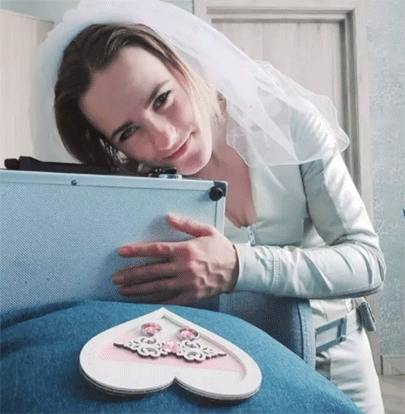
(Rain and Gideon)
We first see documented records of anthropomorphism come with Edward Tyson. Tyson was attempting to treat a chimpanzee that had been captured by sailors and developed ulcers in his mouth in 1689, when the chimp’s human qualities struck him. In his book, “Orang-Outang, Sive Homo Sylvestris: or, the Anatomy of a Pygmy Compared With That of a Monkey, an Ape, and a Man” Tyson compared the chimpanzee to a “caring child” and an old man. Although Tyson was originally a physician, he began to specifically focus on “the improvement of the natural history of animals”, saying that the study of natural history would “unveil the great chain of being” or “the chain of creation”. Believing that humans, were animals, only separated by our closeness to god, divinity being something other animals did not possess.
”Theory of Mind” is the process of taking on another’s perspective, anthropomorphism being an extension of this, as they both activate in the temporoparietal junction. Difficulty with theory of mind is shown to significantly impair social functions and peer relationships, increasing vulnerability to loneliness and feelings of isolation. This evidence shows us that those with neurodivergencies, most notably autism, are likely to expiring anthropomorphism to a much higher extent. Along with comfort seeking and mimicking social behaviors, individuals with autism often perceive themselves as “others”. Meaning that they see little similarity between themselves and their peers, and have a diminished sense of self, allowing to view themselves as “other than human”. Feelings like this make it easier to fall into anthropomorphic behaviors.
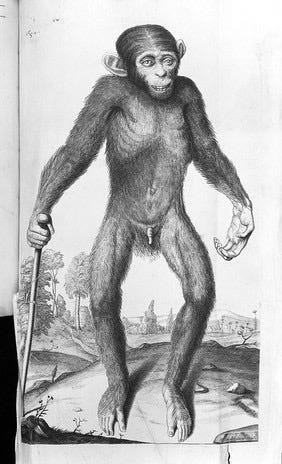
(Tyson’s Chimpanzee, only named “My Chimp”)
Brocarde is a UK based singer and songwriter who married the ghost of a Victorian-Era soldier, Eduardo in 2022. Although many speculate that this was a publicity stunt for her album “Just Another Anthem”, which will line up with her eventual divorce, Brocarde maintains that all of her paranormal encounters are genuine. Brocarde first met Eduardo when he appeared to her in her bedroom, and says he proposed the following Halloween. They’re wedding was a star studded event, with the ghost of Elvis and Marilyn Monroe in attendance, and was officiated by a medium for ease of communication. She wore a black gothic style gown, and had both the ceremony and reception live-streamed on her social media platforms. Married for two years, Brocarde states she had to move to an isolated area just to get away from Eduardo's stalking, and that his inappropriate comments about how good Marylin Monroe looked ruined their wedding, and Eduardo's excessive drinking and inability to pay for anything due to not having a bank card were the top contributors to their quick divorce.
Amanda Teague voices a similar experience, meeting the ghost of an 18th century pirate she calls “Jack” in her bedroom in 2014. Amanda Teague is a Jack Sparrow impersonator from Northern Ireland, and claims the ghost of a Haitian man visited her late one night, while she was in bed. Over several months of communication, Teague learned that Jack had been previously left at the altar, and was ultimately executed for thievery. Amanda states she was “horrified to discover” her romantic feelings, that it was something she had never heard of before. The couple married in a private ceremony in international waters, with a medium translated so Jack could say “I do”, and playing a ring on a lit candle that represented his finger, so the wedding could be legal on paper. The pair did divorce a year later, with Teague saying that communication was just too hard to maintain, later writing a book on her experience, and sparking a multinational debate on whether the marriage could be legal in the first place, with Jack lacking a country of citizenship.
Anthropomorphism being the act of giving objects or animals personality traits, rivals personification, which is the metaphor describing abstract ideas that describe objects as having personality traits. Personification is commonly used in therapeutic settings, allowing for distance between an individual and their illnesses or bad habits. If you were to give your anxiety name like “annoying Angela”, this can allow you take take a step back and observe your anxious traits like overthinking or catastrophizing by saying “annoying Angela is nagging me today” instead of “why am I always doing this and over-identifying with your anxiety. Personification in cases like these can foster self-compassion, just as personification teaches compassion and empathy for children. Children who play with dolls and stuffed animals are actively cultivating a sense of social awareness, just as children who play with race cars and sports equipment are learning assertiveness and the drive for achievement.
The case of “Laundry Monkey”, described by Justing Gregg” is a stark example of anthropomorphism and personification being mainly empathy and compassion based, as well as showing how biology will psh the need for interaction with human-like things. Gregg described walking through the streets of Ireland in the 1990s, when he found a tiny stuffed monkey from a McDonald’s Happy Meal laying on the ground, covered in debris and surrounded by garbage. He was in a hurry to catch his train home, but couldn’t shake the imagery of this monkey's eyes, staring up at him and the painful feeling of leaving him on the street. By the time he made it home, he was overcome with sadness and knew that he needed to go back for Laundry Monkey, finding him exactly where he last saw him. He brought him home to his wife, he gave him his name by running him through the washing machine. Gregg says that Laundry Monkey triggered a “swelling empathy” that was generated by psychological mechanisms, creating an emotional response, even though we all know Laundry Monkey is fabric and plastic, and was not sad about being abandoned.
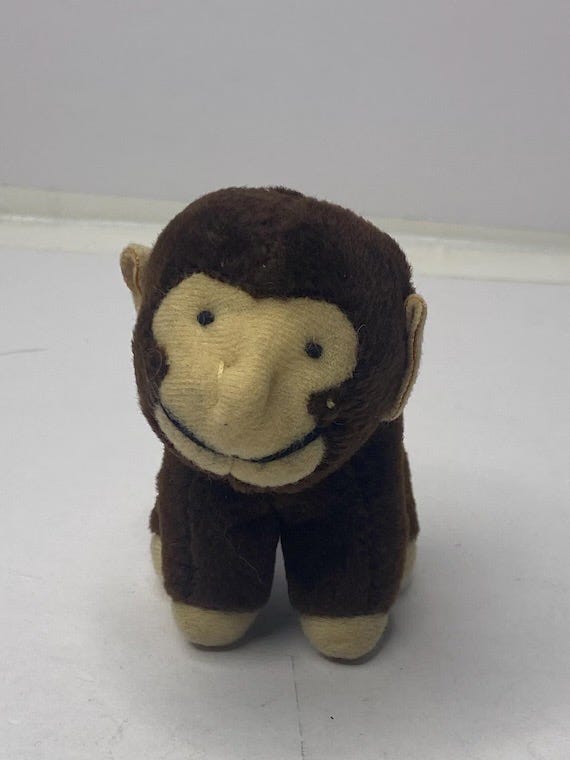
(The same 1994 McDonald’s Happy Meal monkey as Laundry Monkey)
Personalization, anthropromorphism, and anism (attributing life to the lifeless), are all things that we have at least some experience with. Studies done by Gelman in 1983 showed that children as young as three attributed personality and qualities to their blankets and dolls, but had no trouble or confusion differentiating between play and reality. Anthropromorphism takes such a strong hold throughout our lives, that giving names to hurricanes and tornados is listed as one of its top examples. Although it’s likely to anthropomorphize for some more than others, due to neurodivergence or trauma, it’s a biological and psychological response that we all possess. The only take away we could take from this knowledge, is to take notice of yourself and where your actions might come from.
History and Cultural of Stuffed Animals, Kate McKechnie, February 6th, 2026
https://www.alignmaguo.com/winter-23/stuffedanimals
Children Attribute Mental Lives to Toys When They Are Emotionally Attached to Them, Natalia L, Gjersoe, Emily L. Hall, Bruce Hood, January 6th 2015
Why Do We Anthropomorphize?, Sarah Barkley, September 14th 2022
https://psychcentral.com/health/why-do-we-anthropomorphize
What Scientific Term or Concept Ought to be More Widely Known?, Diana Reids, 2017
https://www.edge.org/response-detail/27219
Our Traditional antropomorphic Urges, Justine Gregg, September 11th, 2025
https://www.psychologytoday.com/us/articles/202509/our-irrational-anthropomorphic-urges
Why Do Some People Give Human Feelings to Objects? What Experts Say, Taylor Nicholl, September 7th, 2024
https://www.cnn.com/2024/09/07/health/empathize-inanimate-objects-anthropomorphize-wellness
Seeing More Than Human: Autism and Anthropomorphic Theory of Mind, Gray Atherton, Liam Cross, April 17th, 2018
https://pmc.ncbi.nlm.nih.gov/articles/PMC5932358/
How Personifying Mental Health Struggles Can Heal
https://mindfulstl.com/how-personifying-mental-health-struggles-can-help-you-heal/
Understanding Children’s Toy Choices and Personality Traits
Neurological Development in the Contect of Childhood Trauma
https://pmc.ncbi.nlm.nih.gov/articles/PMC6428430/
Singer Who Married a Ghost Claims He Ruined Their Honeymoon, Jack Hobbs, December 11th, 2022
https://nypost.com/2022/12/11/singer-who-married-a-ghost-claims-he-ruined-their-honeymoon/
Until Death Do You Part? The Strange Case of the Spectral Spouse, Kyle Green
https://uclawreview.org/2019/01/26/until-death-do-you-part-the-strange-case-of-the-spectral-spouse/
Woman Who Married 300-year Old Pirate Ghost Announces Their “Marriage is Over”, Maria Pasquini, December 10th 2018
Russian Woman Marries her Briefcase, Chas Newly-Burden, December 15th, 2020
https://theweek.com/odd-news/951472/russian-woman-marries-her-briefcase
Guest Post: The Psychology of Anthropomorphism. Or Why I Felt Empathy For a Piece of Trash
Hey, i m new at the platform but not at venting,I've been writing small stories lately. About bicycles nobody sold. Notebooks never finished. TV shows that came at 5 PM like a promise. Nothing important. Just the kind of thing that makes you feel a quiet, unnamed something for a minute. Come read, if you have ten minutes and something warm to drink. :)
Reading this made me laugh a little because I realized how often I do this, especially now that I live alone.
I talk to my dogs. I talk to my bread maker. I occasionally negotiate with technology that has stopped cooperating. And there are definitely objects in my house that somehow feel like they have personalities of their own.
The Laundry Monkey story made perfect sense to me. Not because I believe the monkey was sad, but because something in me would have felt sad leaving it there.
Interestingly, anthropomorphism may say less about the object and more about us. Maybe it speaks to our need for connection, meaning, and relationship. Maybe it's one of the ways we bring warmth into a world that can sometimes feel impersonal.
Either way, after reading this, I found myself looking around my house and realizing I might be having a lot more conversations than I thought.