Self Harm Isn’t Poison
Why Self-Harm is Treated Differently From Other Forms of Addiction

The physical act of self harm has been extensively studied for centuries, and dates back in modern medical records to the nineteenth century. Although causes, treatments and classifications vary heavily, self harm is far from a new phenomenon on our radar. The average age of symptom onset is thirteen years old, and statistics of self reported self harm cases show that 9.7% of American teenagers, and 17% of all people worldwide, (this means 11.2 million young women and 16.7 million young men) will participate in self harm. Numbers like these contrasted by media destigmatizing conversation surrounding mental health and addiction, lead me to wonder why self harm, in particular remains taboo and kept quiet.
Although I was a bit of an outlier in age, beginning at eleven, studies correspond correctly for me in more ways than one, but memories can warp over time and I won’t pretend to know exactly what I was thinking or why children like me could think to practice something so extreme. Adolescence is a time when life is changing around you, and your world view and language are so underdeveloped, understanding, let alone communicating emotions so scary or big can be more difficult than we think. At the start of what would become a decade long addiction, the events in my life that provoked it may not have seemed so dramatic from the outside looking in. Self harm for me wasn’t something I thought was wrong or scary at the time, it was something simple and easy that made me feel like I was taking care of things on my own. It became confusing and upsetting when the adults around me seemed to be judging me, it was like I became gross and sick to them overnight. I know now that they were having a fearful reaction, but becoming noticeably different from a previously synchronized family made already negative emotions that much more amplified.
Unfortunately, this seems to be a common experience that even those who don’t self harm can relate to. Peers of mine calling the act “attention seeking”, which really, in a way, it was. Self harm can begin for a lot of reasons, with 11% of participants gaining a mood disorder diagnosis, 13.5% having adjustment disorders, and 20% having personality disorders. Mental illness plays a large role in self harm, and it is important to seek out the appropriate treatments, just as it’s important to recognize causes in our environment. Parents and their teenagers have reported self harm behaviors being brought on by the power of suggestion and exposure, much like substance abuse can be a learned trait. Sources also point to two big reasons that we all experience throughout our lives. One being as a form of self validation and emotional release. If someone is lacking a safe space to communicate their feelings openly, or the coping skills to express themselves, it can be easy to imagine self harm becoming something to lean on. When the things around us are easy to push away, deny or ignore (even to ourselves), self harm brings them into the world to us in a visible and tangible way that represents how we’re feeling. The second, is purely the cry for help, which can become interchangeable with phrases like “attention seeking”. In reality, when someone young and hurt can’t properly verbalize what they need, it could be easy to resort back to memories of getting a band aid and a kiss when you scrape your knee, making it even easier to wonder why those same rules suddenly stopped applying.

(Violet Harmon played by Taissa Farminga)
Feelings of shame, judgement and stigma are among the main contributors stopping teenagers and young adults from seeking treatment. Some, including myself, go to great lengths to conceal their self harm, even missing out on daily life and things they’d otherwise take great joy in. Even though I sometimes chose to attend pool parties, do ballet and wear short sleeves, dresses and shorts despite visible self harm, it was hard to ignore the mood shifting when people around me noticed. Self harm for me was born out of the need to express what I was feeling, but its presence contributed to negative feelings as well. Just as the act of self harm itself is a much older idea than we would think, the stigmatization runs just as deep. America's history with mental health has been known to be tumultuous, and the lack of conversation surrounding it makes research hard to gather, and solutions hard to find.
The first classifications of self harm in medical literature and their severity’s come from Karl Menninger (1938), who considered “self mutilation as a non-fatal expression of an attenuated death wish” creating the term “partial suicide”. He had a system of six, "Neurotic" used for nail biters, skin pickers, those who participated in cosmetic surgery and those who pulled their hair out. “Relgious flagellants”, flagellation being the act of whipping of beating yourself in the name of religious penance, “Puberty Rites” which, I’m sure is self explanatory and very uncomfortable to discuss, "Psychotic", extremity amputation, “organic brain disease”, meaning repetitive and harmful behaviors, such as head banging, biting oneself impulsively, and fracturing your own fingers, as well as “conventional”, things we all do, like clipping our nails, shaving or cutting your hair. Another common classification system in the nineteenth century comes from Pao, who defined between “delicate” and “coarse”, delicate mainly used for young people who would give themselves superficial cuts and were likely to have genetic predispositions like personality disorders, and coarse generally meaning long term or repetitive episodes of psychosis. The system most commonly referred to today makes its way to us in 1979, created by Ross and McKay, which has three much broader categories. First being harmful acts that are deemed mainly acceptable by society, such as piercings and tattoos, things that are moderately accepted like gang tattoos, minor wounds, or ritualistic practices, and then things that are generally not socially acceptable like cutting or burning yourself, or otherwise causing life threatening injuries to oneself.
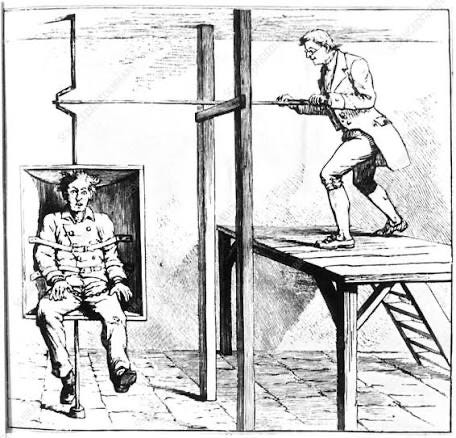
(The 1800’s gyrating chair used to treat depression)
It’s said that those who engage in twenty or more self harm acts are 3.5 times more likely to attempt suicide, but modern day treatments offer an array of theraputic methods to combat self harm and it’s causes. Holistic treatments to manage anxiety include equine therapy, music therapy, art therapy and biofeedback which can help those find the freedom of expression in healthy ways, hopefully leading to lifelong coping skills, if not only to contribute to overall happiness at the time. Common therapeutic methods for addiction are notably helpful for self harm. Contingency management is close to what most of us picture as the twelve step program, offering rewards as positive reinforcement for attending therapies, as well as adding motivation to participate from others in the program. Cognitive behavioral therapy is based on the idea that your thoughts influence your emotions, and your emotions will influence your behaviors, teaching patients to identify the thoughts and feelings behind their addictions and develop positive coping skills in their place. Motivational enhancement therapy uses collaborative conversation to help their participants find motivation for change, and strengthen the belief that they can be successful.
With the understanding that most will seek help from friends instead of traditional methods can really speak to the leading cause, the need for validation. Finding support from those around you will hopefully lead to the same solutions as talk therapy. I’ve been attending talk therapy for around ten years, and not only has it given me a safe and private space to feel emotions in any way I want, it teaches me how to communicate in an effective enough way that those around me can hear what I need, and I can feel I’ve said everything I needed. Talk therapy is beneficial for anyone and everyone willing to try, closing yourself off can only lead to stress, agitation and feelings of isolation.
Although addiction and self harm aren’t always thought of together, I can personally attest to its addictive nature. The reason why methods like snapping a rubber band on your wrist and squeezing ice cubes work, is that it’s a safer alternative to the same feeling self harm causes. Even if eerily similar to how we gave soldiers cocaine to wean them off morphine, long term self harm participants can feel a physical sensation when the urge arises. Other common replacements like drawing on yourself with a red marker, can hopefully provide your brain or nervous system with the same result you’d otherwise have. Of course once recovery begins these urges will weaken and become less frequent over time. Recovery for self harm has a generally positive outlook and a high success rate with 90% of participants stopping by the age of 25 and 70% of patients with suicide attempts disengaging from all risk taking behaviors by the same age.

(Pinterest)
Hopefully most people will never be able to fully understand what leads someone to self harm, and do their best to provide support to those in their life that are struggling. The reason I say that “self harm isn’t poison” is the gap in societal understanding. From a medical and therapeutic standpoint, self harm is under reported, under researched and lacks its own treatments and support systems. Socially, other life altering addictions like substance abuse and alcoholism are typically met with concern and immediate intervention, while first responses to self harm are usually disgust and confusion. While I acknowledge and believe that these things are improving, we have a long way to go with how we make judgements on those around us. 9.7% of American Teenagers are currently struggling with alcohol use disorder, for the same reasons others engage in self harm. How children choose what risk taking behaviors to engage with, isn’t something we can explain away. The causes and solutions are interchangeable, and we owe each other the same concern.
”These Things Don’t Work” Young Peoples Views on Harm Minimazation Strategies As a Proxy For Self Harm : A Mixed methods Approach, Archives for Suicide Research
https://www.tandfonline.com/doi/pdf/10.1080/13811118.2019.1624669
Remission, Recovery, Relapse, and Reoccurance Rates for Suicide Attempts, and Non-Suicidal Injury Youth Treated with Dialectical Behavoir Therapy or Support, PubMed
https://pubmed.ncbi.nlm.nih.gov/38325518/
Evidence-Based Therapy for Addiction Treatment, Stacy Mosel, March 30th 2026
https://americanaddictioncenters.org/therapy-treatment
Self Harm Wikipedia
https://en.wikipedia.org/wiki/Self-harm
Prevalence of Past-Year Alcohol Use Disorder, August 2025
Non-Suicidal Reasons for Self Harm: A systemic Review of Self Reported Accounts, Amazonia Edmondson, Cathy A. Brennan, Allan O.House, August 23rd 2015
https://www.sciencedirect.com/science/article/pii/S0165032715307485
Self Harm Statistics, The Recovery Village
https://www.therecoveryvillage.com/mental-health/self-harm/self-harm-statistics/
This is so beautiful thought out and very fresh on your writing really enjoyed your story had subscribe. I actually would like to keep in touch and get your thoughts on my stories as well would you care to join my free subscription so we can engage with other and be part of our substack family ❤️
"आपने बहुत ही सटीक और मार्मिक विषय उठाया है। हमारा जीवन अक्सर एक ऐसी प्रणाली में बँधा है जहाँ हम सामाजिक विसंगतियों और कठिन परिस्थितियों के कारण खुद को असहाय महसूस करने लगते हैं। मुझे लगता है कि इन तमाम समस्याओं की जड़ में 'चेतना का बिखराव' और प्रेम व समानुभूति की कमी ही है। मेरा अपना जीवन इस संघर्ष का एक जीता-जागता उदाहरण है, इसीलिए मैं निरंतर प्रेम के प्रसार और मानवीय बंधुत्व की अपील करता हूँ।"