How Stupid Are Racists?
Where Racism Really Comes From

With America facing an ever evolving and growing fight against racism, our history can show racism is built on lies and purposeful manipulation. Stereotypes pushed onto black individuals stems from the Atlantic Slave Trade era, laziness, lewdnes and dishonesty made up by capturers, ship captains and torturers purely to justify their business and gain control. To perpetuate and excuse racism today is to acknowledge, you’re following the lies of men long dead, to gain power and uphold a hierarchy to benefit you, alone.
“Black Lives Matter” is a civil rights activist network, created and gaining media attention with a hashtag campaign. Three Black Women, Alicia Garza, Patrice Cullors and Opal Tomti started this movement in response to George Zimmerman being found not guilty of the second degree murder of Trayvon Martin. Trayvon was a seventeen year old living in Miami Gardens, FL, when a local part-time student and neighborhood watch captain called 911 to report a suspicious person. Despite being told not to exit his vehicle, Zimmerman approached Martin and claimed to have shot him in self defense. Although now being mainly recognized for a focus on police brutality and a failing justice system, their goal is stated as: “To support the development of new black leaders, as well as to create a network where black people feel empowered to determine their own destinies in their communities”
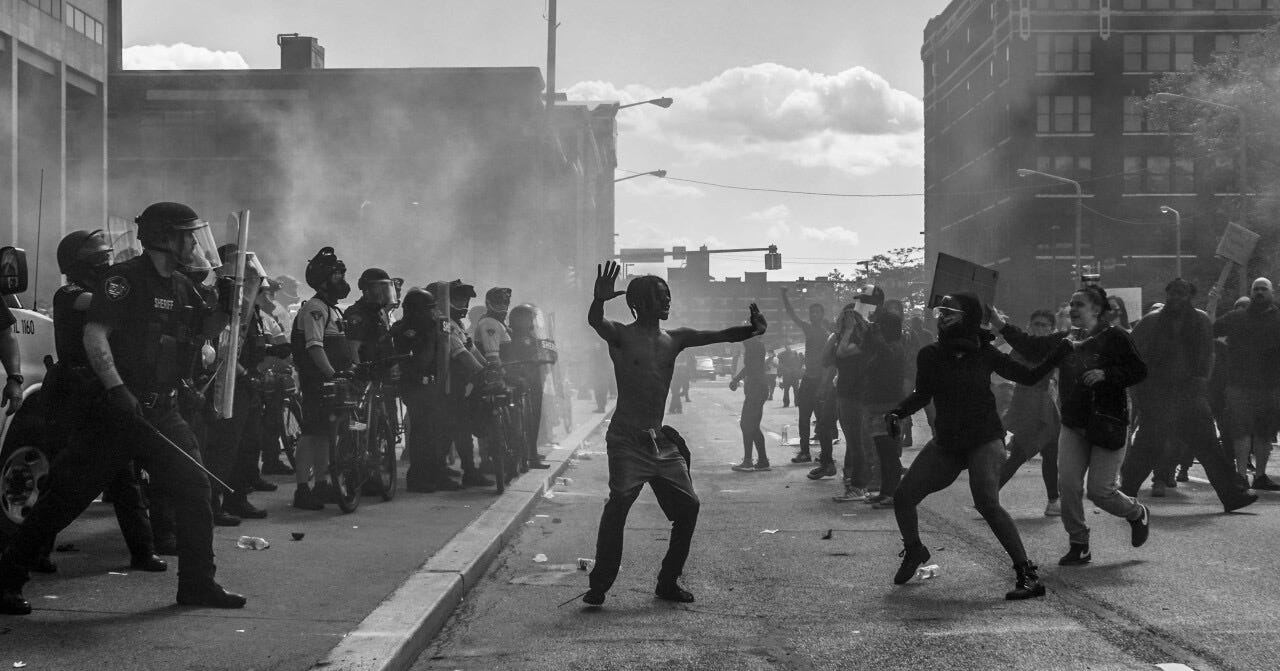
(Black Lives Matter Protest, Cleveland.)
Aside from the modern-day uphill battle against racially biased violence, and long held stereotypes, our postracial America self reports many moral failings in racial equity. The “AACP”’s released policy statement reflects that, the second leading cause of death in teens aged 10-19 is suicide, which will increase statistically by 60% in black teens, making them over twice as likely to commit suicide. Data shows that community violence, discrimination stress, bias and stigma, and interpersonal/family conflicts are greater predictors in suicide of black adolescents, as mental health conditions are often misdiagnosed as behavioral issues, diagnosis that could raise alarm bells for an increased risk. The same report shows that black teens are less likely to receive quality care and/or follow up care for crisis and hospital services, which continues to create a distrust in our health care system, leading to slower, if any, intervention.
Many sources place pressure on the family, stating that the statistical increased risk is due to a lack of fostered racial identity, and socialization in communities. Although racial socialization is a clear and important part of the development of coping skills and advocacy, racism is a rare case where it stems from a large-scale community effort and can only be fought with equal call. Thomas Jefferson is famously quoted as “The real distributions which nature has made will produce convulsions which will probably never end, but in the extermination of another race”. This heavy and loaded statement shines a light on both how far we’ve come, and how far we have to go.
The stereotyping of Black Americans is mainly identified after the emancipation proclamation, as a radical form of controlling the established hierarchy, but does stem all the way back to the Atlantic Slave Trade as a means of self-justifying the mistreatment of captured slaves. The full truth of rampant slavery in the south can be seen in facts like dark skinned people having already developed an immunity to malaria and the average southern in the 1700s having a life expectancy of forty two years old. We needed them as a means for our own survival.
Considered a widely extreme emancipationist (not an abolitionist, which was considered violent at the time), Cassius Clay is best known for the release of all the slaves left to him in his will by 1832, enduring extreme backlash while campaigning and spurring Lincoln on the release of the emancipation proclamation. The story of Cassius Clay is bizarre, long and harrowing, but paints a fantastic picture of antislavery acts in the 1840s, 50s and 60s. Clay was shot in the chest while making a speech, had his newspapers headquarters lined with mortar cannons and pike sticks from fear of an attack, and was beaten so close to death that the Lexington Post had printed his obituary, only to retract less than a year later. His most affirming action in emancipation being that he returned the US, briefly from his post as an ambassador in Russia in 1862, to find a “depressed Lincoln” worrying on whether or not Kentucky would join the union, and how this could affect the emancipation proclamation. Clay travelled to Kentucky and brought the information he gathered back to Lincoln, that he thought Kentucky would join the union, Lincoln then released the emancipation proclamation in September of the same year.
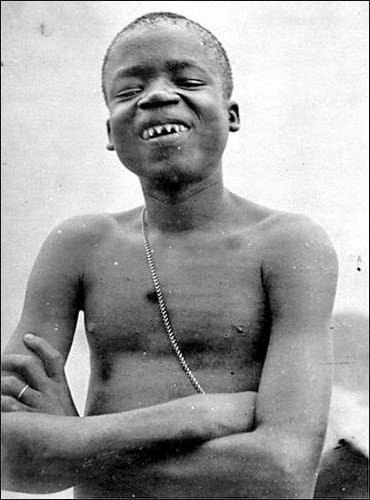
(Ota Benga, a young black man sold to the human zoo at the world showcase in St. Louis 1883-1916)
To accentuate the immense passion and energy shown by the abolitionists and emancipationists, other than extreme acts of public violence, students were often expelled from their universities for discussing issues of race, abolitionists and women’s rights activists were pitted against each other (later banning together), as women were not permitted in political discussions, with no knowledge of decontamination, sanitizing, and little medical technology life expectancy was on average 47.3 years old by 1900. For so many, this meant dedicating the majority of their energy, time and life to the freeing of slaves.
In 1964, at thirty five years old, Martin Luther King Jr became the youngest person to win the Nobel Peace Prize, after leading the March on Washington, holding non-violent campaigns, being attacked by police dogs and water hoses. Although today, we recognize Martin Luther King Jr. for his bravery, passion, knowledge and love., he violence Martin Luther King Jr faced is terrifyingly similar to the abolitionists before him, and the protesters with Black Lives Matter today.
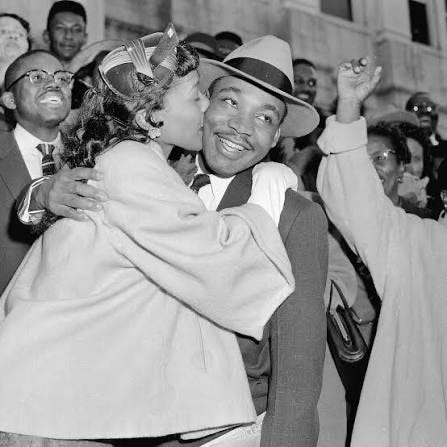
(Martin Luther King Jr.)
As of 2023, 51% of US adults self-report as supporting the Black Lives Matter movement, varying in cultures, 81% of African Americans, 61% of Hispanic Americans, 63% of Asian Americans and 42% of White Americans, support has generally deteriorated from previous years. Stories like Cassius Clay's and Trayvon Martin’s, being separated by 151 years, force us to take quotes like Thomas Jefferson’s much more seriously. Being able to compare stories like these show us how deeply embedded racism has become and how relevant in our communities it remains. Knowing that it comes from ourselves and why, should have enabled us to admit that to perpetuate racism in modern society, to excuse it, to ignore it is to accept and follow the lies and manipulation of a society long gone.
American History of Slavery Began Long Before Jamestown, Crystal Ponti, August 14th 2019
https://www.history.com/articles/american-slavery-before-jamestown-1619
Learning Together, Where did Racism Begin?, Sarah Price, July 17th, 2020
https://admissions.nd.edu/visit-engage/stories-news/learning-together-where-did-racism-begin/
Racism in the United States, Elizabeth Mohn 2024
https://www.ebsco.com/research-starters/social-sciences-and-humanities/racism-united-states
The Development, Evolution and Maintence of the Structural Racism for Studies of Health Inequities, an Expanded Framework Asian, Black, Hispanic, and White Americans, PubMed, July 2025
https://pmc.ncbi.nlm.nih.gov/articles/PMC12503062/
Making Sense of Black Lives Matter Movement and the Black Experience in the United States, February 2026
https://libguides.utsa.edu/blacklivesmatter
Black Lives Matter Official Website
https://blacklivesmatter.com/our-history/
Views on the Black Lives Matter movement, Juliana Menasce Horowitz Braga, June 14th 2023
https://www.pewresearch.org/social-trends/2023/06/14/views-on-the-black-lives-matter-movement/
Trayvon Martin Fast Facts, CNN, February 12th 2026
https://www.cnn.com/us/trayvon-martin-shooting-fast-facts
A Wold by the Ear, Gabriel Rebels and Cotton Became King, Greg Jackson (History Doesn’t Suck), July 22nd 2018
https://open.spotify.com/episode/4JgCXePXuNVAQPUnRK4z45?si=OdfDDIEqTo-M9tt_4hjL3w
Popular and Pervasive Stereotypes of African Americans, NMAAHC
https://nmaahc.si.edu/explore/stories/popular-and-pervasive-stereotypes-african-americans
From Crib to Coffin, Navigating Coping From Racism Related Stress Throughout the Lifespan of Americans, February 2nd 2022
https://pmc.ncbi.nlm.nih.gov/articles/PMC8807348/
AACP Policy Statement on Increased Suicide Among Black Youth in the U.S
Systemic and Structural Rcism: definitions, examples, health damages and approaches to dismantling, Paula A Bracemen, February 7th 2022
https://www.healthaffairs.org/doi/10.1377/hlthaff.2021.01394
Stragegies and Activities for Reducing Racial Prejudice and Racism, Chris Hampton, Kien Lee
Abolitionist Cassius Clay, “The Dallop” with Dave Anthony and Gareth Reynolds
https://open.spotify.com/episode/5AKU4zoSeFvCE36e2JEnFp?si=s9w0FSe3QQaGCSmkwsK_KA
About Dr.Martin Luther King Junior
https://thekingcenter.org/about-tkc/martin-luther-king-jr/
Why Life Expentancy Skyrocketed in 20th Century America
https://www.history.com/articles/life-expectancy-rise-20th-centur
Photograph by Yousuf Karsh
it astounds me that in the year 2026 some people are still bothered by others’ skin color. We all the same inside divided we fall united we conquer
"आपकी बातों ने इस विषय की गंभीरता को और अधिक गहराई प्रदान कर दी है। यह सच है कि इक्कीसवीं सदी की चकाचौंध के बीच आज भी हम अपनी पुरानी मानसिकता से पूरी तरह मुक्त नहीं हो पाए हैं। स्वरूप और तरीके बदल गए हैं, लेकिन भेदभाव की जड़ें अब भी उतनी ही गहरी हैं।
मेरा मानना है कि जब तक हम अपनी चेतना को जागृत नहीं करेंगे और प्रेम व बंधुत्व के भाव को व्यापक स्तर पर प्रसारित नहीं करेंगे, तब तक यह समस्या जड़ से समाप्त नहीं हो पाएगी।
सामाजिक चेतना को जागृत करने के लिए आपका यह प्रयास और विषय की ओर ध्यान दिलाना वास्तव में सराहनीय है। यह विषय केवल अमेरिका का नहीं, बल्कि संपूर्ण मानवता का है, जिस पर निरंतर संवाद की आवश्यकता है। अपनी संवेदनाओं को साझा करने के लिए आपका हृदय से आभार।"